No. A diploma is not automatically a university degree in the UK. Diplomas and degrees are different types of qualifications, although in some cases they can sit at the same qualification level.
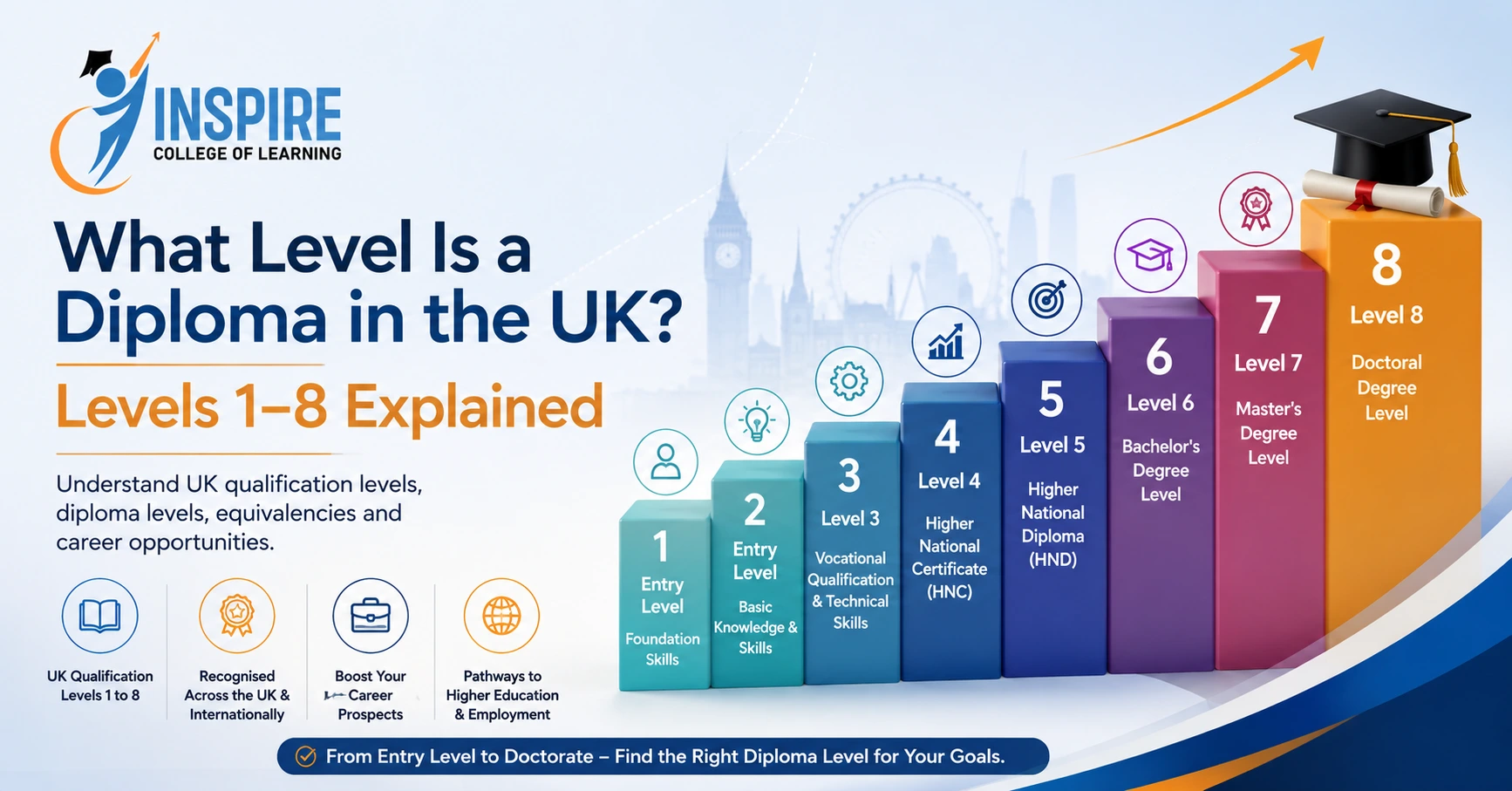
For example, a Level 6 Diploma and a bachelor's degree can both sit at Level 6, while a Level 7 Diploma and a master's degree can both sit at Level 7. That tells us something about the level of learning involved; it does not mean the qualifications are identical.
This small distinction prevents a great deal of confusion.
If you are choosing between a diploma and a degree, the question is not simply which one sounds more impressive. You need to consider what qualification you will actually receive, who awards it, what level it sits at, how much study it involves, whether it meets the requirements of your intended career and what it allows you to do afterwards.
What Is a Diploma?
A diploma is a qualification awarded after completing a defined programme of study and assessment.
There is no single “diploma level” in the UK. Diplomas can exist at different stages of education and may be designed for academic, vocational, technical or professional purposes.
This is why two courses containing the word diploma can be remarkably different.
A Level 3 Diploma may support entry into higher-level learning or professional development, while a Level 6 or Level 7 Diploma may involve substantially more advanced study.
The word diploma, therefore, does not tell the whole story.
When considering one, look at:
-
its full qualification title;
-
qualification level;
-
awarding organisation;
-
study size or credit value where applicable;
-
assessment methods;
-
entry requirements; and
-
recognised progression opportunities.
If you first want to understand how the individual levels compare, see our guide to what level a diploma is in the UK.
What Is a University Degree?
A university degree is a higher education qualification such as a Bachelor of Arts (BA), Bachelor of Science (BSc), Bachelor of Engineering (BEng), Master of Arts (MA) or Master of Science (MSc).
In England, Wales and Northern Ireland, bachelor's degrees normally sit at Level 6, while master's degrees sit at Level 7.
Degrees are awarded by institutions or bodies authorised to make recognised degree awards. One useful detail is often overlooked: the institution where someone studies is not necessarily the institution that awards the degree.
A college, for example, may teach a programme that leads to a degree awarded by another university or recognised degree-awarding body.
So when considering any programme advertised as a degree, check not only where you study, but also who awards the final qualification.
Diploma vs Degree: What Is the Difference?
The difference cannot be reduced to the familiar claim that diplomas are “practical” while degrees are “academic”.
Some diplomas are strongly vocational, but others involve considerable theoretical study. Equally, many university degrees — nursing, engineering, teaching and social work are obvious examples — combine theory with substantial professional or practical learning.
A more useful comparison looks like this:
| Factor | Diploma | University Degree |
|---|---|---|
| Qualification type | Diploma qualification | Degree such as BA, BSc, MA or MSc |
| Level | Can exist at several qualification levels | Bachelor's normally Level 6; master's Level 7 |
| Awarding body | Depends on the particular qualification | Awarded by a recognised degree-awarding body |
| Study focus | May be vocational, technical, professional or academic | Usually broader higher education study, becoming more specialised at advanced stages |
| Duration | Varies considerably between qualifications | Bachelor's degrees normally involve several years of study |
| Assessment | May include assignments, projects, portfolios and practical assessment | May include coursework, exams, projects, placements and research |
| Research/dissertation | Not necessarily required | Often forms part of degree study, particularly at advanced levels |
| Career use | Depends on the qualification and occupation | Required or preferred for some professional and graduate roles |
| Further study | Some diplomas provide progression to higher qualifications or university | Bachelor's degrees commonly provide a route towards postgraduate study |
| Final award | The stated diploma qualification | A recognised degree title |
Neither column is automatically “better”.
Their value depends on the purpose for which the qualification is being taken.
Can a Diploma Be at the Same Level as a Degree?
Yes.
This is the source of much of the confusion surrounding diploma and degree comparisons.
UK qualification levels describe the relative difficulty or demand of learning. They do not make every qualification at a particular level identical.
Two qualifications can therefore occupy the same level while differing in size, purpose, structure, assessment and final award.
A useful rule is:
Same level does not mean same qualification.
That matters particularly at Levels 6 and 7.
Is a Level 5 Diploma a Degree?
No. A Level 5 Diploma is not a bachelor's degree.
Level 5 sits below Level 6, where bachelor's degrees are normally positioned in England, Wales and Northern Ireland.
Other qualifications found at Level 5 include the Higher National Diploma (HND), Diploma of Higher Education (DipHE) and foundation degree.
Level 5 can nevertheless be an important point in a person's education. Certain Level 5 qualifications may provide progression towards degree-level study, including advanced entry arrangements in some circumstances.
That possibility belongs to the specific qualification and receiving institution, however. It should not be assumed from the words “Level 5” alone.
Is a Level 6 Diploma the Same as a Bachelor's Degree?
No.
A Level 6 Diploma and a bachelor's degree can both sit at Level 6, but they remain different qualifications.
This distinction is clearly visible in the UK qualification framework, where Level 6 Diplomas and bachelor's degrees are listed separately.
Someone who completes a Level 6 Diploma receives the diploma stated on the qualification. They do not automatically receive a BA, BSc or another bachelor's degree title.
This becomes particularly important when a job, professional body or university asks specifically for a bachelor's degree.
If an application says:
“Bachelor's degree required”
it is safer not to assume that any Level 6 qualification will automatically meet that requirement.
The employer, university or professional authority ultimately decides which qualifications it accepts.
Is a Level 7 Diploma the Same as a Master's Degree?
No.
The principle is exactly the same at Level 7.
Master's degrees, postgraduate diplomas, Level 7 Diplomas and several other postgraduate-level qualifications can sit at Level 7. Sharing that level indicates a comparable level of learning demand; it does not give every qualification the same title or study volume.
A person holding a Level 7 Diploma should therefore describe the qualification accurately rather than calling it an MA, MSc or MBA.
Some Level 7 Diplomas may support progression towards a master's qualification where a university has an appropriate route.
If postgraduate study is your intended destination, our guide to what a Level 7 Diploma is equivalent to explores this distinction in greater detail.
Can a College Diploma Be University Level?
Yes.
A qualification does not need to carry the word degree to involve higher-level learning.
Level 4, Level 5, Level 6 and Level 7 qualifications can all represent advanced study. Some may be delivered by colleges, training providers or other education institutions rather than through the conventional university experience.
What matters is the qualification itself.
Check:
-
what qualification is awarded;
-
its recognised level;
-
who awards it;
-
whether it is regulated where applicable; and
-
what progression or professional rights it provides.
“University level” and “university degree” are not interchangeable expressions.
A qualification can involve learning at a level associated with higher education without itself being a bachelor's or master's degree.
Who Actually Awards a University Degree?
This is worth checking before enrolling.
Not every institution that teaches a degree programme has the authority to award its own degrees.
A college may deliver the teaching while the final degree is awarded by a university or another body with recognised degree-awarding powers.
For that reason, prospective applicants should ask a very simple question:
Whose name will appear as the awarding body on my final degree?
For recognised UK degrees, official government guidance can be used to check whether the awarding institution is authorised to issue recognised degree awards.
This is especially useful when a programme is delivered through a partnership, franchise or college arrangement.
Does a Diploma Count as a Degree for Jobs?
Not automatically.
The answer depends on what the employer actually requires.
If a vacancy asks for knowledge or qualifications at a particular level, an appropriate diploma may satisfy the employer's requirements.
If the vacancy specifically requires a bachelor's degree, however, a Level 6 Diploma should not automatically be described as one simply because both sit at Level 6.
There are also professions where qualification requirements are determined by professional regulators or legislation. In those cases, the precise approved qualification matters considerably more than a general level comparison.
The safest approach is to read the job specification literally.
If uncertain, ask the employer whether the exact qualification you hold or intend to study satisfies its requirements.
Can a Diploma Lead to a University Degree?
Yes, some diplomas can provide routes towards university study.
But there is no universal rule stating that every diploma gives entry to every university.
The Access to Higher Education Diploma, for example, is specifically intended to prepare eligible adults for higher education. Other professional or higher-level qualifications may also be accepted for university admission or advanced entry depending on the qualification and institution.
If a degree is your eventual destination, there is a sensible way to plan the journey:
Start with the university, not the diploma.
First identify the degree you eventually want to study.
Then check:
-
its entry requirements;
-
qualifications accepted for admission;
-
whether your intended diploma is recognised;
-
whether entry would be into Year 1 or a later stage;
-
whether credit transfer or advanced standing is available; and
-
whether any additional requirements apply.
Only after those questions have been answered should you choose the diploma.
That is much safer than completing a qualification first and asking whether a university will accept it afterwards.
Can You Top Up a Diploma to a Degree?
Sometimes, but not every diploma has a degree top-up route.
The expression “top-up degree” is commonly used for programmes designed to allow someone with suitable previous higher education study to complete the remaining credits needed for a bachelor's degree.
Certain HNDs, foundation degrees and other recognised higher-level qualifications may provide routes into such programmes.
However, the receiving university decides:
-
which qualifications it accepts;
-
how much previous study it recognises;
-
whether the subject is sufficiently related;
-
what credit can be transferred; and
-
which stage of the degree a person can enter.
A qualification should therefore never be purchased solely on an informal promise that it “can be topped up”.
Look for a clear progression arrangement and confirm it with the university concerned.
When Might a Diploma Make More Sense Than a Degree?
University is not the only meaningful route to professional development.
A diploma may deserve serious consideration when you:
-
already work in a sector and want to develop more advanced professional knowledge;
-
need a qualification at a particular level rather than specifically requiring a degree;
-
want to change career and build knowledge in a new field;
-
need a flexible study model alongside employment or family responsibilities;
-
intend to progress through a confirmed route towards further study;
-
prefer a qualification concentrated on a particular professional field; or
-
do not presently need the broader commitment of a full university degree.
For an experienced professional, the right diploma can be more useful than beginning a qualification simply because it carries the word degree.
The reverse can also be true.
The qualification should serve the destination.
When Might a University Degree Be the Better Choice?
A university degree is likely to deserve priority when:
-
your intended profession specifically requires an approved degree;
-
graduate schemes you intend to apply for require a bachelor's degree;
-
your future postgraduate programme requires an undergraduate degree;
-
professional registration depends upon completion of a recognised degree;
-
you want the broader academic experience associated with a full degree programme; or
-
your career plans depend specifically on holding a BA, BSc or other degree award.
There is little value in choosing a shorter or more flexible qualification if it cannot satisfy the requirement that matters most at the end.
How Can You Check Whether a Diploma Is Regulated?
Before enrolling, verify the qualification rather than relying entirely on a course advertisement.
For regulated qualifications in England and Northern Ireland, the Register of Regulated Qualifications allows people to check whether a qualification is officially regulated, view detailed information and compare similar qualifications.
When researching a diploma, check for:
-
full qualification title;
-
awarding organisation;
-
qualification number;
-
qualification level;
-
Total Qualification Time or credits where stated;
-
current qualification status;
-
assessment structure; and
-
progression information.
The awarding organisation is particularly important.
A provider may teach a qualification, but the organisation responsible for awarding it can be different.
That distinction should always be clear before enrolment.
Is a UK Diploma Recognised Internationally?
UK qualifications are studied and used around the world, but international recognition should never be assumed from a UK level number alone.
A Level 6 Diploma should not automatically be presented overseas as a bachelor's degree, nor should a Level 7 Diploma automatically be presented as a master's degree.
Universities, employers, professional regulators, government authorities and credential-evaluation services may consider several factors when assessing a qualification, including:
-
awarding-body status;
-
qualification level;
-
entry requirements;
-
study duration;
-
curriculum and learning outcomes;
-
assessment;
-
progression rights; and
-
the requirements of the destination country.
This matters to anyone intending to use a UK qualification in the UAE, Saudi Arabia, Qatar, Bahrain, Oman, Europe, the United States or elsewhere.
For people who need their UK qualification explained for employment or further study overseas, UK ENIC offers a UK Qualification Reference Statement service containing detailed information about eligible UK qualifications.
Recognition ultimately depends on the organisation making the admission, employment, licensing or regulatory decision.
A Note About Scotland
The qualification numbering discussed above primarily reflects the framework commonly used to compare qualifications in England, Wales and Northern Ireland.
Scotland has its own qualification framework and different level numbering.
Anyone intending to study, work or progress to higher education in Scotland should therefore check the relevant Scottish qualification level rather than assuming that the same number represents the same stage of learning throughout the UK.
Diploma or Degree: Which Should You Choose?
A century ago, education choices were fewer and the route into many professions was comparatively narrow. Today, there are more ways to acquire serious knowledge — but abundance creates its own difficulty.
The sensible choice begins with the end.
Ask yourself:
What do I actually need this qualification to do for me?
If you need a bachelor's degree for your profession, choose a route that clearly leads to a bachelor's degree.
If you already work in your chosen field and need structured professional development, a relevant diploma may be more appropriate.
If university progression is the goal, check the university's requirements before choosing the preceding qualification.
If you hope to work internationally, investigate recognition in the country where you intend to use the qualification.
Then compare the practical details:
1. Qualification awarded
Will you receive a diploma, BA, BSc, MA, MSc or another recognised qualification?
2. Qualification level
What level is the programme, and does that level suit your existing education?
3. Awarding organisation
Who is legally or academically responsible for awarding the qualification?
4. Course content
Does the programme teach knowledge relevant to your intended career or further study?
5. Study commitment
Can you realistically complete the required study alongside your existing responsibilities?
6. Assessment
Will you be assessed through assignments, projects, examinations, practical work or research?
7. Progression
What can holders of this exact qualification reasonably progress to?
8. Recognition
Will the employer, university, professional regulator or international authority that matters to you accept it?
A course title can attract attention. These questions determine its actual value.
Studying a Professional Diploma with Inspire College of Learning
Inspire College of Learning provides online professional qualifications across areas including business management, health and social care, law, cyber security, information technology, psychology, education and other professional fields.
Online learning can be particularly useful for people who wish to continue working while developing new knowledge or progressing academically.
Flexibility, however, should be considered alongside the qualification itself.
Before selecting a programme, applicants should review the qualification level, awarding organisation, entry requirements, assessment approach and progression opportunities. International applicants should also check any recognition requirements that apply in the country where they intend to work or continue their education.
The purpose is not simply to obtain another certificate.
It is to choose a qualification that makes sense as part of a larger educational or professional journey.
So, Is a Diploma a University Degree?
No. A diploma is not automatically a university degree.
Some diplomas can sit at the same qualification level as university degrees. A Level 6 Diploma may sit alongside bachelor's degrees at Level 6, while a Level 7 Diploma may sit alongside master's degrees at Level 7.
But level tells us about the standard of learning — not that two qualifications are identical.
A diploma remains the diploma that was awarded. A bachelor's degree remains a bachelor's degree. A master's degree remains a master's degree.
The important question is therefore not:
“Which one sounds higher?”
It is:
“Which qualification gives me the knowledge, recognition and progression I need for what I want to do next?”
Once that destination is clear, the choice between a diploma and a degree becomes much easier.
Frequently Asked Questions
Q1. Is a diploma the same as a degree in the UK?
No. A diploma and a degree are different qualification types. Some diplomas can sit at the same qualification level as degrees, but sharing a level does not make them the same award.
Q2. Is a Level 5 Diploma a degree?
No. Level 5 is below the Level 6 normally associated with bachelor's degrees in England, Wales and Northern Ireland. Some Level 5 qualifications may provide progression towards degree study, depending on the qualification and university.
Q3. Is a Level 6 Diploma equivalent to a bachelor's degree?
A Level 6 Diploma and a bachelor's degree can sit at the same qualification level, but a Level 6 Diploma is not itself a bachelor's degree. The final qualification title, size and progression arrangements remain different.
Q4. Does a Level 6 Diploma count as a degree for employment?
Not automatically. If an employer specifically requires a bachelor's degree, confirm whether it accepts your exact Level 6 qualification rather than assuming that matching the qualification level is sufficient.
Q5. Is a Level 7 Diploma the same as a master's degree?
No. Level 7 Diplomas and master's degrees can both sit at Level 7, but they are different qualifications. A Level 7 Diploma should not be described as an MA, MSc or MBA unless that degree has actually been awarded.
Q6. Can a diploma lead to university?
Yes, some diplomas provide routes into university study. Admission and advanced entry depend on the exact qualification and the receiving university's requirements.
Q7. Can I top up a diploma to a bachelor's degree?
Some higher-level qualifications can provide routes into top-up degree programmes, but this is not available for every diploma. The receiving university determines whether previous learning is accepted and how much credit can be recognised.
Q7. Is an online diploma recognised?
Recognition depends on the qualification, awarding organisation and the requirements of the employer, university or professional body considering it. Whether learning takes place online does not by itself establish or remove recognition.
Q8. Can international applicants use a UK diploma for further study?
Potentially, yes. Universities and authorities outside the UK apply their own admission and recognition policies. Applicants should confirm acceptance of the exact qualification before relying on it for overseas study, employment or professional licensing.