Ask someone what level a diploma is and you may receive several different answers. One person will tell you Level 3. Another will mention Level 5. Someone else may describe a Level 7 Diploma as a postgraduate qualification.
Curiously, all three may be right.
A diploma does not have one fixed qualification level in the UK. Diplomas can exist at different levels, from introductory qualifications to advanced study. The number attached to the qualification — Level 2, Level 3, Level 5 or Level 7, for example — tells you far more than the word diploma by itself.
That distinction matters. A Level 3 Diploma and a Level 7 Diploma may share the same word in their titles, yet they represent very different standards of learning.
What Does the Word “Diploma” Actually Mean?
There are two things worth looking at whenever you encounter a qualification: its level and its size.
The level tells you about the difficulty and complexity of the knowledge and skills expected. A higher number generally represents more advanced study.
The size tells you how much study is involved.
Ofqual's Regulated Qualifications Framework makes this distinction deliberately. Two qualifications can sit at the same level while requiring different amounts of study, just as two qualifications of a similar size can sit at different academic levels.
For Ofqual-regulated qualifications using the standard Award, Certificate and Diploma titles, a Diploma is a larger qualification. Under Ofqual's naming rules, an Award has up to 120 hours of Total Qualification Time (TQT), a Certificate has 121–369 hours, while a Diploma has 370 hours or more.
That is why asking only, “Is it a diploma?” is rarely enough.
A better question is: "What level is the diploma, who awards it, how large is it, and where can it lead?"
UK Diploma Levels at a Glance
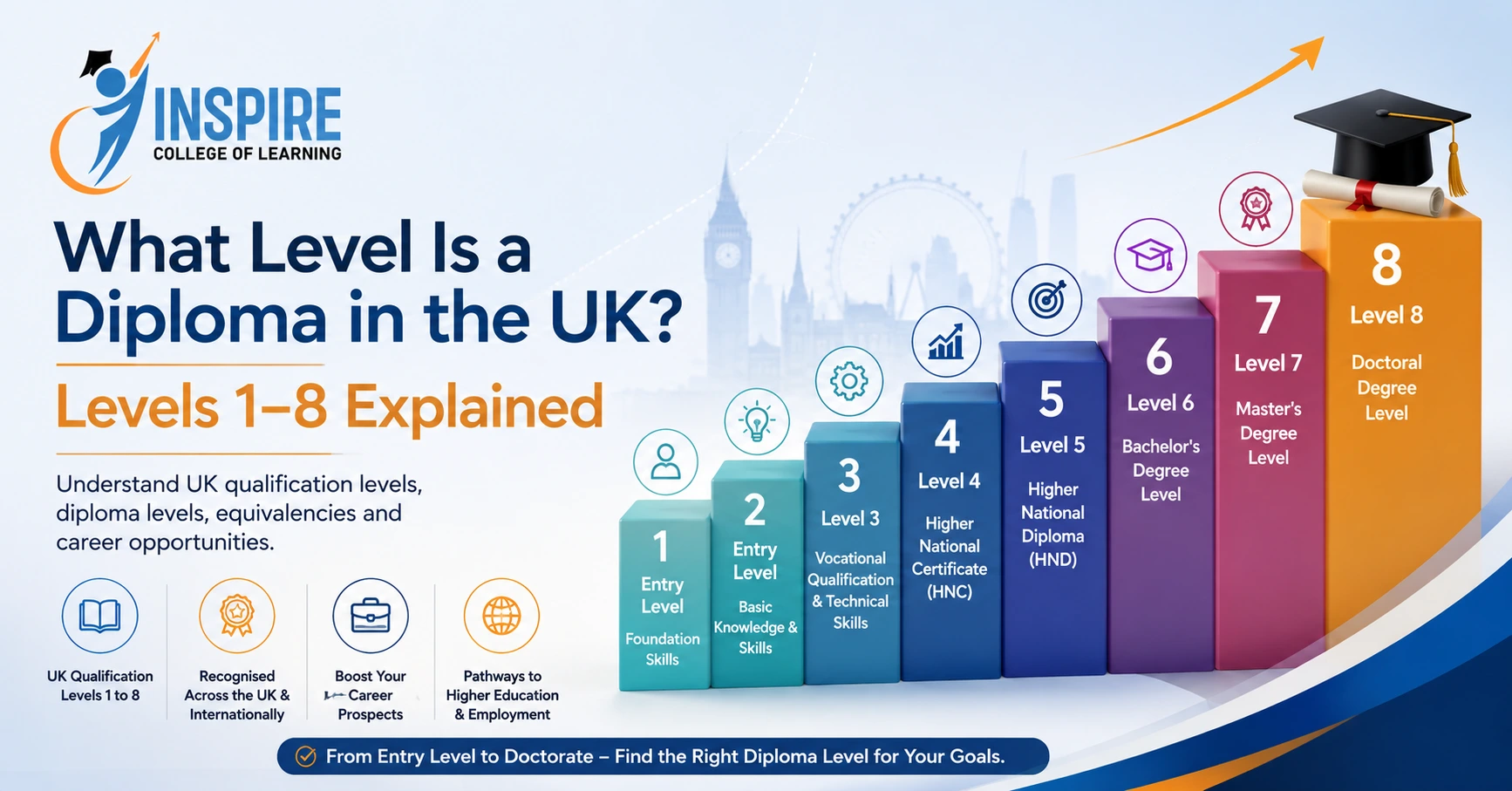
For qualifications in England, Wales and Northern Ireland, GOV.UK uses Entry Level followed by Levels 1 to 8 for general comparison.
| Qualification Level | Examples at the Same Level |
|---|---|
| Entry Level | Entry Level Diploma, Entry Level Certificate |
| Level 1 | Level 1 Diploma, GCSE grades 3–1 |
| Level 2 | Level 2 Diploma, GCSE grades 9–4 |
| Level 3 | Level 3 Diploma, A Level, Access to HE Diploma, T Level |
| Level 4 | Level 4 Diploma, HNC, Certificate of Higher Education |
| Level 5 | Level 5 Diploma, HND, Diploma of Higher Education, foundation degree |
| Level 6 | Level 6 Diploma, bachelor's degree, degree apprenticeship |
| Level 7 | Level 7 Diploma, master's degree, postgraduate diploma, PGCE |
| Level 8 | Level 8 Diploma, doctorate |
The most important words in this table are “at the same level.”
Qualifications sharing a level should not automatically be treated as identical, interchangeable or equal in study volume. They may differ substantially in purpose, content, assessment, credits and progression opportunities.
What Is a Level 2 Diploma?
Level 2 sits below advanced further education and is commonly associated with qualifications designed to build practical or occupational knowledge.
Other Level 2 qualifications include GCSEs at grades 9–4 and Level 2 certificates.
A Level 2 Diploma can make sense for someone beginning a new vocational field, developing foundational workplace knowledge or preparing to progress to a Level 3 qualification.
Its usefulness depends much more on the particular qualification and subject than on the Level 2 label alone.
What Is a Level 3 Diploma?
Level 3 represents more advanced further education.
A Levels, T Levels and the Access to Higher Education Diploma also sit at Level 3, although they are very different qualifications with different purposes.
This is where comparisons often become misleading.
A Level 3 Diploma is at the same qualification level as an A Level, but this does not mean every Level 3 Diploma should simply be described as “the same as A Levels”.
The qualification's size, subject, awarding organisation and progression arrangements still matter.
Level 3 study is commonly considered by people preparing for employment, professional development or progression into higher-level education.
Level 3 Foundation Diploma for Higher Education Studies
What Is a Level 4 Diploma?
Level 4 is the point at which qualifications begin to sit alongside recognised higher-level awards such as the Higher National Certificate (HNC) and Certificate of Higher Education (CertHE).
You will sometimes see Level 4 described online as “equivalent to the first year of university”.
That description can be useful as a rough illustration, but it should not be interpreted as meaning that every Level 4 Diploma automatically gives someone the first year of a bachelor's degree.
A Level 4 Diploma is its own qualification.
Whether it can provide entry or advanced standing towards another programme depends upon the specific diploma and the institution considering it.
For working adults, Level 4 can be particularly useful when moving beyond introductory professional knowledge into more analytical, supervisory or specialist study.
What Is a Level 5 Diploma?
Level 5 is above Level 4 and below Level 6.
Qualifications at Level 5 include the Higher National Diploma (HND), Diploma of Higher Education (DipHE) and foundation degree.
This makes Level 5 an interesting point in the qualification framework. It offers advanced study without necessarily requiring someone to complete a bachelor's degree at that stage.
Some Level 5 Diplomas are designed with professional or vocational progression in mind. Others may offer routes towards higher-level qualifications or university study.
However, progression should never be assumed merely because a qualification carries the number 5.
Before enrolling, check:
-
the full qualification title;
-
the awarding organisation;
-
the qualification size or credit value where applicable;
-
entry requirements;
-
assessment methods; and
-
confirmed progression arrangements.
That last point is particularly important if the eventual goal is a university degree.
Is a Level 5 Diploma a Degree?
No.
A Level 5 Diploma is a Level 5 qualification, while a UK bachelor's degree normally sits at Level 6.
Some Level 5 qualifications may support progression towards a degree or allow entry to a later stage of a particular degree programme, but this depends on the qualification and university.
There is an important difference between a progression route towards a degree and already possessing a degree.
Level 5 Diploma in Health and Social Care Management OTHM
Is a Level 6 Diploma the Same as a Bachelor's Degree?
No — although they can sit at the same qualification level.
GOV.UK lists both Level 6 Diplomas and bachelor's degrees at Level 6.
That tells us that both involve learning assessed at Level 6 complexity. It does not turn one qualification into the other.
Someone who completes a Level 6 Diploma receives the diploma specified by the awarding organisation. They do not automatically receive a BA, BSc or bachelor's degree.
This distinction matters when an employer, university, professional regulator or immigration authority specifically asks for a degree rather than simply a Level 6 qualification.
It is therefore safer to say:
A Level 6 Diploma can be at the same framework level as a bachelor's degree, but it is not automatically a bachelor's degree.
Is a Level 7 Diploma the Same as a Master's Degree?
Again, no — and this is probably the most commonly misunderstood diploma comparison.
A Level 7 Diploma and a master's degree can both sit at Level 7. Master's degrees, postgraduate diplomas, postgraduate certificates and Level 7 Diplomas can all appear at this level.
What they do not necessarily share is the same qualification type, study volume, research requirement or awarding route.
A Level 7 Diploma therefore demonstrates Level 7 study, but it should not simply be renamed as a master's degree.
Certain Level 7 qualifications may offer progression towards an MBA, MSc, MA or another master's programme. Where such a route exists, the receiving university determines its own admission and credit-recognition requirements.
If master's progression is your eventual objective, investigate the progression arrangement before enrolling rather than assuming every Level 7 Diploma leads to the same destination.
What a Level 7 Diploma is equivalent to?
Can You Get a Level 8 Diploma?
Yes.
Level 8 is the highest numbered level in the framework used for qualifications in England, Wales and Northern Ireland, and GOV.UK includes Level 8 Diplomas among qualifications at this level.
Doctorates such as the PhD also sit at Level 8.
Once again, however, sharing Level 8 does not turn a Level 8 Diploma into a doctorate. Qualification level and qualification type remain separate questions.
Is a Higher Level Always Better?
Not necessarily.
Education is not a staircase on which everyone ought to climb to the highest numbered step as quickly as possible.
The most useful qualification is usually the one that sits at the right point between where you are now and where you intend to go next.
Someone entering a profession may gain far more from an appropriate Level 2 or Level 3 qualification than from applying prematurely for higher-level study.
An experienced manager, by contrast, may find introductory study far below their existing knowledge and instead meet the entry requirements for Level 5, 6 or 7.
The subject matters just as much as the number.
A Level 5 qualification in health and social care and a Level 5 qualification in business management occupy the same qualification level, but they prepare people to develop very different bodies of knowledge.
Do You Have to Complete Every Diploma Level in Order?
No.
There is no universal rule requiring everyone to complete Level 3, then 4, then 5, then 6 and finally 7.
Entry depends on the requirements of the specific qualification.
Previous education, relevant professional experience and recognised prior learning may sometimes allow entry at a higher level. In other circumstances, a particular earlier qualification may be required.
This is why two people pursuing similar careers can follow quite different education routes.
Qualification frameworks describe levels of learning. They are not, by themselves, compulsory step-by-step study plans.
How Do You Know Whether a Diploma Is Regulated?
This is one of the most useful checks you can make before paying for a qualification.
For regulated qualifications in England and Northern Ireland, the GOV.UK Register of Regulated Qualifications allows you to check whether a qualification is regulated and view information about the qualification and awarding organisation.
Before enrolling in a professional diploma, look for:
-
the full qualification title;
-
the awarding organisation;
-
the official qualification number where applicable;
-
the qualification level;
-
qualification size, TQT or credits where supplied;
-
entry requirements; and
-
progression information.
Be cautious of a course page that relies heavily on phrases such as degree equivalent or master's equivalent without clearly stating what qualification is actually awarded.
The certificate you eventually receive matters more than a marketing comparison.
What About Diploma Levels in Scotland?
Scotland uses a different qualification framework.
The Scottish Credit and Qualifications Framework (SCQF) contains 12 levels rather than the Entry Level–Level 8 structure commonly used for comparison in England, Wales and Northern Ireland.
For example, Scottish bachelor's, honours and master's qualifications are positioned differently within the SCQF numbering system.
Anyone studying, working or progressing to higher education in Scotland should therefore check the SCQF level rather than assuming that an English Level 7 and a Scottish Level 7 describe the same stage of education.
Are UK Diploma Levels Recognised in the UAE, Europe or the United States?
A UK qualification can be studied or used internationally, but UK qualification levels should not be converted into foreign qualifications by assumption.
A Level 6 Diploma does not automatically become a bachelor's degree in another country simply because a UK bachelor's degree also sits at Level 6.
Likewise, a Level 7 Diploma should not automatically be presented abroad as a master's degree.
Recognition may depend on:
-
the awarding organisation;
-
the particular qualification;
-
the employer or university considering it;
-
local education rules;
-
professional or licensing requirements; and
-
formal credential evaluation where required.
For comparisons between UK and non-UK qualifications, GOV.UK directs individuals to UK ENIC, the UK's national information centre for international qualifications.
This point is especially important for people planning to use a UK qualification for employment, regulated professions, immigration or further education overseas.
Check the requirements of the destination institution or authority before enrolling.
Which Diploma Level Should You Choose?
Begin with your destination rather than the course catalogue.
Ask yourself:
What am I trying to achieve?
Perhaps you are entering a new sector. Perhaps you already work in the field and want formal recognition of more advanced knowledge. Perhaps your goal is university progression, professional development or eventual postgraduate study.
Once that is clear, consider:
Your current qualifications
Check whether your existing education satisfies the published entry requirements.
Your professional experience
Relevant experience may matter for some higher-level professional qualifications.
Your intended career
Choose a subject and qualification that develop knowledge relevant to the work you actually intend to pursue.
Your next qualification
If further study matters, investigate the next stage now rather than after completing the diploma.
Recognition
Confirm the awarding organisation, regulation status and any requirements imposed by employers, universities or professional bodies relevant to your plans.
Study format
For working professionals, online study can provide valuable flexibility, but flexibility should never replace careful checking of the qualification itself.
Choosing an Online Diploma with Inspire College of Learning
Inspire College of Learning provides online professional qualifications across fields including business management, health and social care, cyber security, law, psychology, data science, education and other professional areas.
Programmes are available across different qualification levels, which means the highest-numbered course is not automatically the appropriate starting point.
A prospective applicant should first consider their previous education, experience and intended progression. The next step is to examine the individual programme's awarding organisation, qualification level, entry requirements, assessment structure and progression information.
For someone balancing education with employment or family commitments, online learning can make professional study considerably more accessible. The academic decision, however, remains the same as it has always been: choose a qualification for what it enables you to learn and where it can reasonably take you next.
So, What Level Is a Diploma?
There is no single diploma level.
A diploma may exist at Level 2, Level 3, Level 4, Level 5, Level 6, Level 7 or even Level 8, as well as at lower levels.
The number tells you the level of difficulty and complexity. The qualification title and specification tell you what has actually been achieved.
That is the distinction worth remembering.
A Level 6 Diploma may sit at the same level as a bachelor's degree without being a bachelor's degree. A Level 7 Diploma may sit at the same level as a master's degree without becoming an MA, MSc or MBA.
So when comparing qualifications, do not stop at the word diploma.
Look at the level, size, awarding organisation, subject, assessment and progression route together.
Only then does the title begin to tell the whole story.
Frequently Asked Questions
Q1. Is a diploma Level 3 or Level 4?
A diploma can be Level 3, Level 4 or another qualification level. The word “diploma” does not determine the level. You need to check the number included in the full qualification title.
Q2. Is a Level 3 Diploma equivalent to A Levels?
Level 3 Diplomas and A Levels can sit at the same qualification level, but they are different qualifications and may vary in size, purpose, assessment and progression opportunities.
Q3. Is a Level 4 Diploma a degree?
No. A Level 4 Diploma is a Level 4 qualification. Higher National Certificates and Certificates of Higher Education also sit at Level 4, while bachelor's degrees normally sit at Level 6.
Q4. Is a Level 5 Diploma equivalent to a degree?
A Level 5 Diploma is below the Level 6 at which bachelor's degrees normally sit. Some Level 5 qualifications can provide progression towards degree study, subject to the receiving institution's requirements.
Q5. Is a Level 6 Diploma a bachelor's degree?
No. A Level 6 Diploma and a bachelor's degree can both sit at Level 6, but they remain different qualification types.
Q6. Is a Level 7 Diploma a postgraduate qualification?
Level 7 represents postgraduate-level study and includes qualifications such as master's degrees, postgraduate diplomas and Level 7 Diplomas. The exact status and title of an individual qualification should always be checked.
Q7. What is the highest diploma level in the UK?
For the framework used to compare qualifications in England, Wales and Northern Ireland, Level 8 is the highest numbered level and Level 8 Diplomas can exist. Scotland uses the separate 12-level SCQF system.
Q8. Can I progress from one diploma level to another?
Often, yes, but progression is not automatic. Entry requirements vary between qualifications, awarding organisations and education providers. Previous qualifications and professional experience may also affect where you can begin.
Q9. Can international applicants study a UK diploma online?
Many UK qualifications are delivered online to international applicants, but admission, recognition and progression depend on the specific qualification and destination country. Applicants intending to use a qualification in the UAE, Europe, the United States or elsewhere should check local employer, university, professional and regulatory requirements before enrolling.