Diploma vs Certificate vs Qualification
When people compare courses, the words diploma, certificate, award and qualification can appear to mean much the same thing. They do not.
A diploma is a type of qualification. So, if you are asking for another general name for a diploma, qualification is the safest broader term. But it is not an exact synonym: certificates, degrees and other awards can also be qualifications.
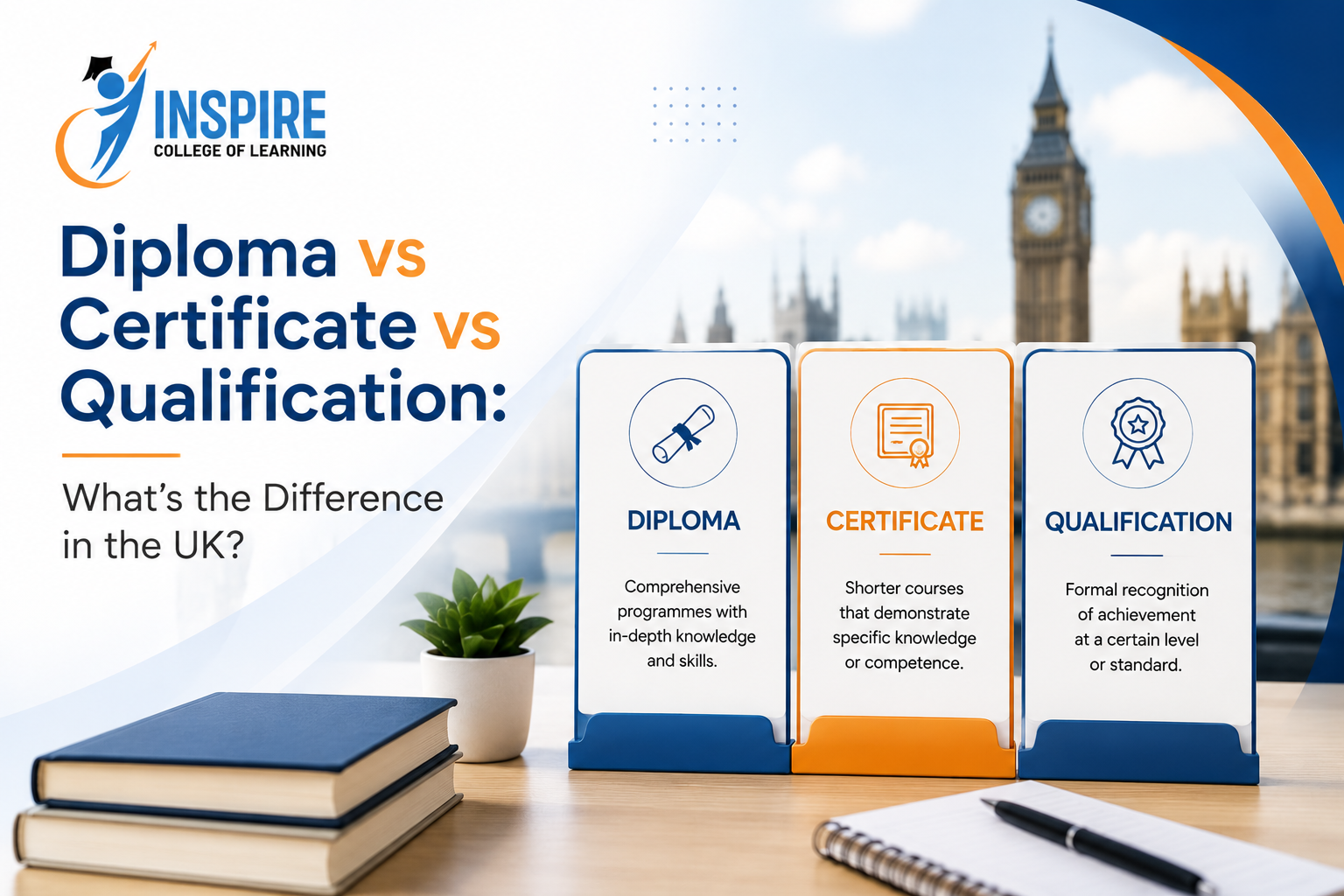
There is another distinction that matters just as much. In many regulated UK qualifications, words such as Award, Certificate and Diploma can tell you something about the size of the qualification, while its numbered level tells you about the difficulty of the learning. Ofqual’s qualification-title guidance uses Award for small qualifications, Certificate for medium-sized qualifications and Diploma for larger qualifications.
Once those two ideas — level and size — are separated, UK qualification titles become considerably easier to understand.
What Is a Qualification?
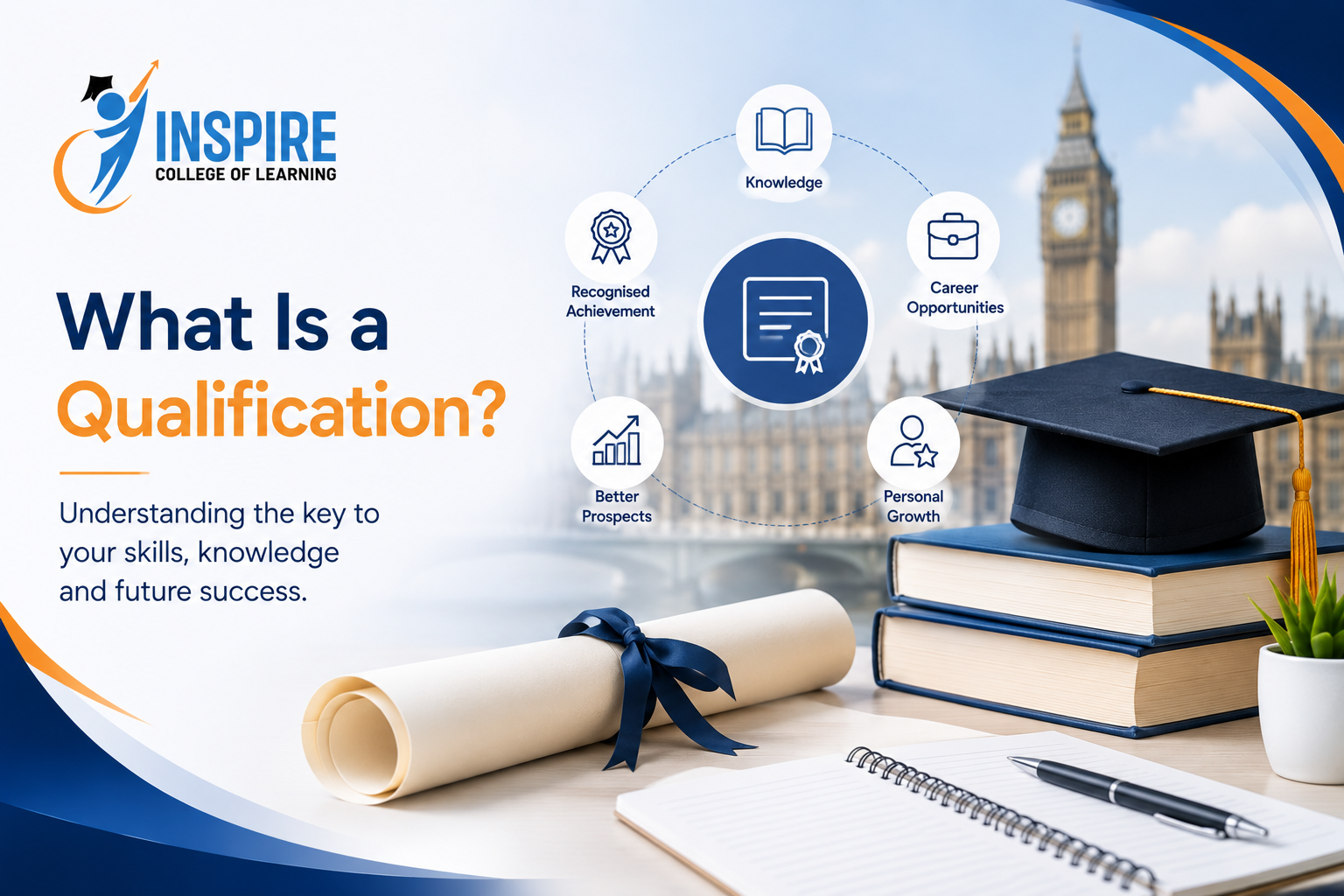
A qualification is the broadest term in this discussion.
Diplomas, certificates and degrees can all be qualifications. The word tells you that a defined programme of learning and assessment has been completed, but it does not by itself tell you what type or level of qualification was achieved.
Think of it this way:
A diploma is a qualification, but not every qualification is a diploma.
The same principle applies to degrees and certificates.
This is why a course page that simply says “gain a recognised qualification” does not yet tell you enough. Before enrolling, you should know the full qualification title, awarding organisation, level, size, assessment requirements and intended progression.
For regulated qualifications in England and Northern Ireland, the official Register of Regulated Qualifications can be used to check whether a qualification is regulated, view detailed information and compare similar qualifications.
What Is a Diploma?
A diploma is a specific type of qualification rather than a general word for all educational achievements.
Diplomas can appear at different qualification levels and in many subject areas. The word diploma alone therefore does not tell you whether the study is introductory, intermediate or advanced.
In Ofqual’s current title guidance for regulated qualifications, the term Diploma is a positive indicator of a large-sized qualification with 370 or more hours of Total Qualification Time (TQT).
Total Qualification Time is broader than classroom or tutor-led study. It represents an estimate of the overall time reasonably required to achieve the qualification, including guided learning and other study, preparation and assessment activity.
This gives us an important rule:
“Diploma” can tell you about qualification type and, in relevant regulated qualifications, size. It does not tell you the level by itself.
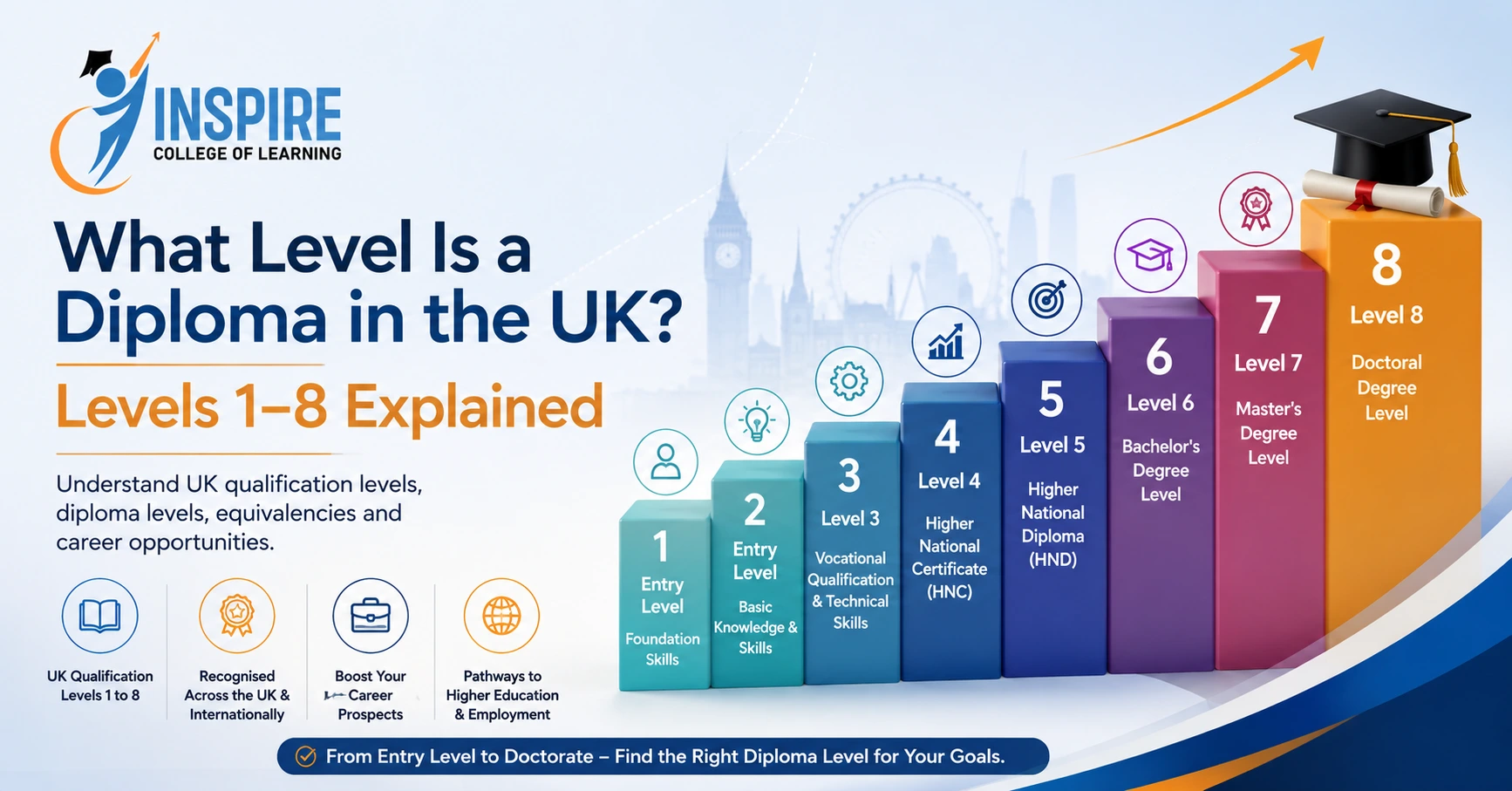
A Level 3 Diploma and a Level 7 Diploma are both diplomas, but they represent very different levels of learning.
For a full explanation of those numbered levels, see our guide to what level a diploma is in the UK.
What Is a Certificate?
A certificate can mean two different things in everyday education language, and confusing them causes unnecessary problems.
A certificate as a qualification
The word Certificate may form part of the official qualification title.
Under Ofqual’s title guidance, Certificate is used as a positive indicator for a medium-sized qualification with 121 to 369 hours of Total Qualification Time.
For example, someone might complete a qualification whose formal title contains:
Level 4 Certificate in [Subject]
Here, Certificate describes the qualification type.
A certificate as evidence of achievement
People also use the word certificate to describe the physical or digital document they receive after successfully completing a qualification.
That does not change the title of the qualification.
If you complete a Level 5 Diploma, the document confirming your achievement may casually be called your certificate, but the qualification itself remains a Level 5 Diploma.
This is a small distinction, but an important one when writing a CV, completing a university application or explaining a qualification to an employer.
What Is an Award?
The word award also has more than one use.
In ordinary language, someone may refer broadly to a degree, diploma or certificate as an academic award.
But within Ofqual’s qualification-title guidance, Award has a more specific role. It is used as a positive indicator of a small-sized qualification with 120 hours of Total Qualification Time or less.
So an Award, Certificate and Diploma at the same qualification level can still represent different amounts of learning.
That leads to one of the most useful principles in this entire subject:
Same level does not mean same size.
And equally:
Same size does not mean same level.
Award vs Certificate vs Diploma: What Is the Difference?
For many Ofqual-regulated qualifications, the comparison can be understood like this:
| Qualification Term | Typical Size Under Ofqual Guidance | What It Mainly Tells You |
|---|---|---|
| Award | Up to 120 TQT hours | Small qualification |
| Certificate | 121–369 TQT hours | Medium-sized qualification |
| Diploma | 370+ TQT hours | Large qualification |
| Qualification | No single size | Broad term covering different qualification types |
| Degree | Separate higher education qualification type | Higher education award made under degree-awarding powers |
These size descriptions come from Ofqual’s guidance on qualification titles. They should not be treated as a universal naming rule for every educational course in every country or for every qualification outside Ofqual’s regulatory scope.
The title is one clue. The full qualification specification tells you much more.
Qualification Level vs Qualification Size
This is where course comparisons often go wrong.
Level and size answer different questions.
Qualification level asks:
How demanding is the learning?
GOV.UK explains qualification levels as a way of indicating difficulty, with higher levels representing more demanding learning.
Qualification size asks:
How much learning is involved?
Ofqual uses Total Qualification Time to represent the estimated total amount of time needed to achieve a regulated qualification.
Imagine two qualifications at the same level:
-
Level 5 Certificate
-
Level 5 Diploma
They may both involve Level 5 learning, but the Diploma can represent a larger volume of study.
This is why comparing courses only by their level can be misleading.
A useful comparison considers both:
Level + Size + Subject + Awarding Organisation + Progression
Diploma vs Certificate in Higher Education
Higher education has its own qualification conventions too.
QAA’s higher education frameworks apply to degrees, diplomas, certificates and other academic qualifications awarded by degree-awarding bodies at Level 4 and above in England, Wales and Northern Ireland, with a separate framework structure applying in Scotland.
Within higher education, QAA explains that the title diploma generally indicates a larger volume of learning than a certificate but a smaller volume than a degree.
For example:
-
a Certificate of Higher Education (CertHE) is normally at Level 4;
-
a Diploma of Higher Education (DipHE) is normally at Level 5;
-
graduate certificates and graduate diplomas can be at the same level but differ in study volume;
-
postgraduate certificates and postgraduate diplomas can both sit at Level 7 while involving different volumes of learning.
This is another reason not to treat certificate and diploma as interchangeable words.
The title carries information.
Is a Diploma Just Another Name for a Certificate?
No.
A Certificate and Diploma may both be qualifications, and in casual conversation people sometimes use certificate to refer to the document proving achievement.
But when Certificate and Diploma form part of official qualification titles, they should be treated as different terms.
If your formal award is:
Level 5 Diploma in Business Management
you should not list it on your CV as:
Level 5 Certificate in Business Management
Changing one word can change the meaning of the qualification.
Use the title that appears on the official qualification record or certificate.
Is a Diploma Another Name for a Degree?
No.
A diploma and a degree are different types of qualifications.
They can sometimes sit at the same qualification level without becoming the same qualification. This is why a Level 6 Diploma should not simply be renamed a bachelor’s degree, or a Level 7 Diploma renamed a master’s degree.
QAA’s higher education framework also makes clear that qualifications at the same framework level can involve different volumes of learning and different intended outcomes.
If this is the distinction you are trying to understand, see our complete guide to diploma vs degree in the UK.
Is “Credential” Another Word for Diploma?
Sometimes, but mainly in a broad or international sense.
Credential is commonly used to describe evidence of education, training, competence or professional achievement. It can include qualifications, licences, certificates and other recognised achievements depending on the context.
In UK course information, however, qualification is generally the clearer broad term when discussing a diploma.
If the official award is a Diploma, use Diploma when precision matters.
There is little advantage in replacing an accurate qualification title with a vaguer word.
Course Name vs Qualification Name: Why the Difference Matters
Education websites sometimes use shortened or marketing-friendly course names.
For example, a page may be headed:
Business Management Diploma
That may be perfectly useful for someone browsing the website.
But the official regulated qualification can have a much more precise title containing information about:
-
the awarding organisation;
-
qualification level;
-
qualification type;
-
subject or content.
Ofqual’s guidance expects qualification titles to avoid misleading users and identifies the awarding organisation, level and appropriate qualification terminology as positive indicators of a compliant title.
Before enrolling, therefore, do not stop at the page headline.
Ask:
What is the exact qualification I will receive?
That question can save a remarkable amount of confusion later.
Why Does the Official Qualification Name Matter?
It matters because other organisations make decisions from the qualification you actually hold, not from an informal description of it.
When writing your CV
Use the complete qualification title wherever practical.
Instead of:
Business Diploma
use the actual title, such as:
Level 5 Diploma in [Subject]
and include the awarding organisation where useful.
When applying to university
Universities may want to understand:
-
qualification title;
-
awarding organisation;
-
level;
-
credits or study volume;
-
subject content;
-
transcript;
-
grades; and
-
progression arrangements.
A vague description such as business qualification makes that assessment more difficult.
When applying internationally
Do not change the qualification title because another country's education terminology seems similar.
For example, a Level 7 Diploma should not automatically be rewritten as master’s degree for an overseas application.
Provide the exact UK qualification first. Let the receiving university, employer, professional body or credential-evaluation authority decide how it should be recognised.
How to Check the Official Name of a Regulated Qualification
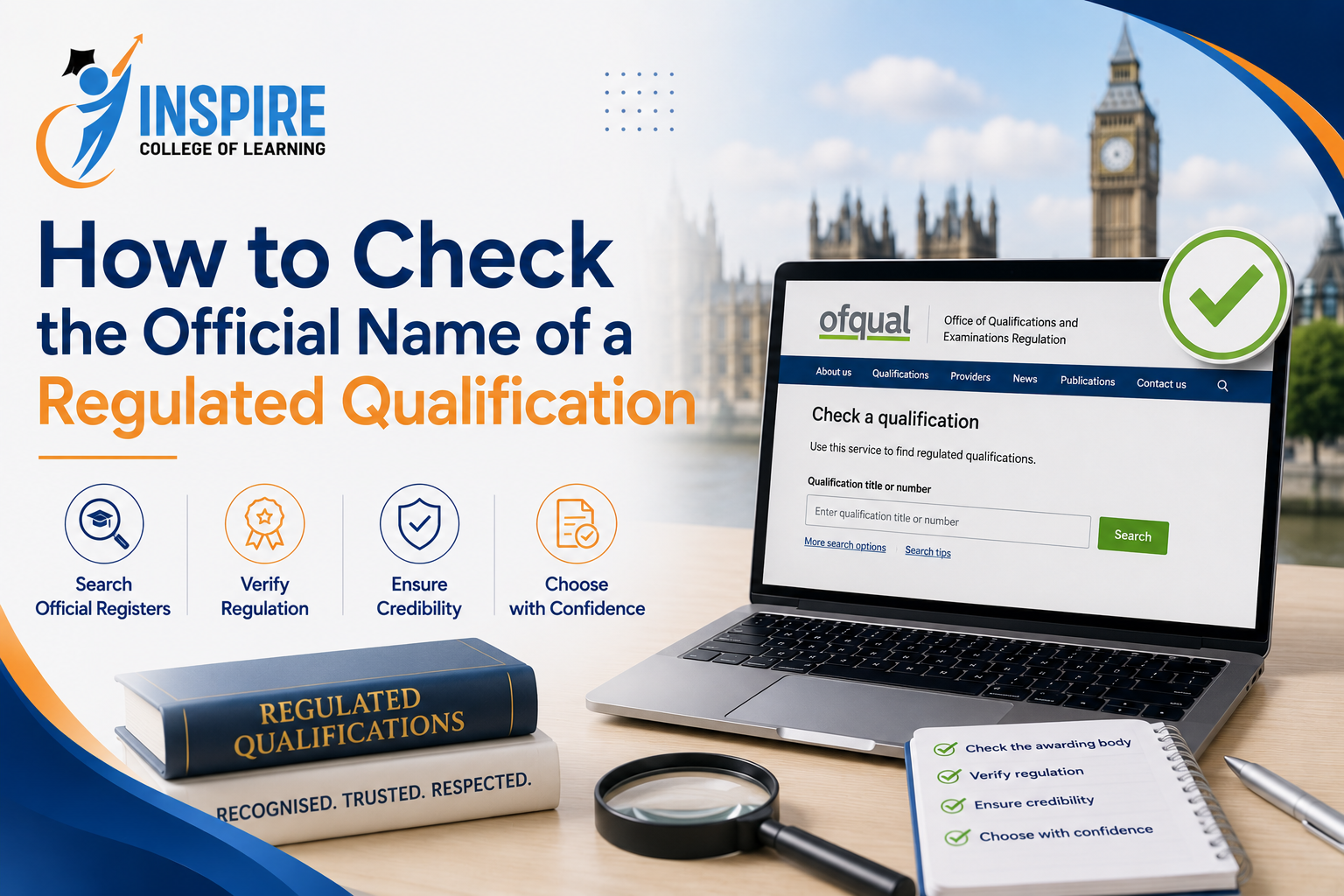
For qualifications regulated in England and Northern Ireland, GOV.UK provides access to the Register of Regulated Qualifications. The service can be used to confirm whether a qualification is regulated, view detailed information and compare similar qualifications.
Before enrolling, check as many of the following as apply:
-
Full qualification title
-
Awarding organisation
-
Qualification number
-
Qualification level
-
Total Qualification Time
-
Guided Learning Hours
-
Qualification status
-
Assessment requirements
-
Progression information
You can also check whether the awarding organisation itself is officially regulated in England or Northern Ireland through GOV.UK’s regulated awarding organisation service.
This takes only a little time and is far more reliable than judging a programme by an advertisement alone.
What Should You Check Before Choosing a Diploma or Certificate?
Do not choose simply because Diploma sounds more impressive than Certificate.
A larger qualification is not automatically the right qualification.
Consider:
The level
Is the study appropriate for your current education and professional experience?
The size
How much learning and assessment does the qualification involve?
The subject
Does it actually develop knowledge relevant to your intended career or further education?
The awarding organisation
Who is responsible for awarding the qualification?
The assessment
Will you complete assignments, projects, examinations, practical assessment or another form of assessment?
The progression route
If your long-term goal is university or another qualification, has that route been confirmed?
Recognition
Does the employer, university, professional body or overseas authority that matters to you accept the qualification?
A title is helpful. These details determine whether the qualification suits your purpose.
Understanding Qualification Titles at Inspire College of Learning
Inspire College of Learning offers online professional study across areas such as business management, health and social care, law, cyber security, information technology, education and other professional fields.
When comparing programmes, applicants should look beyond the shortened course name and review the exact qualification information provided for the programme.
The most useful details are:
-
qualification title;
-
awarding organisation;
-
level;
-
study requirements;
-
assessment;
-
entry criteria; and
-
progression opportunities.
This is particularly important for working professionals and international applicants who may be choosing a UK qualification for a specific employment or further-study purpose.
Online flexibility can make education easier to fit around existing responsibilities. It does not remove the need to choose the right qualification.
So, What Is Another Name for a Diploma?
If you need a broad term, qualification is the safest answer.
A diploma is a type of qualification.
But Certificate, Award and Degree should not automatically be used as alternative names for a Diploma because they can represent different qualification types, sizes and outcomes.
In many Ofqual-regulated qualifications:
Award = smaller qualification
Certificate = medium-sized qualification
Diploma = larger qualification
while the level tells you about the difficulty of the learning.
So perhaps the better question is not, “What else can I call my diploma?”
It is:
“What is the exact name of my qualification, and what does that title tell me?”
When applying for employment, university or further study, use that official title.
Precision serves you better than a synonym.
Frequently Asked Questions
Q1. What is another word for diploma in the UK?
Qualification is the safest broader term. A diploma is a type of qualification, but not every qualification is a diploma.
Q2. Is a qualification the same as a diploma?
Not exactly. A diploma is one type of qualification. Certificates, degrees and other awards can also be qualifications.
Q3. Is a certificate the same as a diploma?
No. Certificate and Diploma can be separate qualification titles. In Ofqual’s qualification-title guidance, Certificate generally indicates a medium-sized qualification, while Diploma indicates a larger qualification.
Q4. What is the difference between an Award, Certificate and Diploma?
Under Ofqual’s title guidance, Award is used as a positive indicator for qualifications with up to 120 TQT hours, Certificate for 121–369 hours and Diploma for 370 hours or more.
Q5. Is the certificate I receive the same as a Certificate qualification?
Not necessarily. A physical or digital certificate may simply be evidence that you completed a qualification. If you completed a Diploma, the qualification remains a Diploma even if you call the document itself a certificate.
Q6. Is a diploma the same as a degree?
No. Diplomas and degrees are different qualification types. They can sometimes sit at the same qualification level without being the same award.
Q7. Does the word Diploma tell me the qualification level?
No. Diplomas can exist at different qualification levels. You need the full qualification title and level to understand the standard of study.
Q8. What should I call my diploma on a CV?
Use the exact formal qualification title wherever possible, including the level and subject. Adding the awarding organisation can also make the qualification clearer.
Q9. How can I check whether a diploma is regulated?
For qualifications in England and Northern Ireland, search the GOV.UK Register of Regulated Qualifications using the qualification title, awarding organisation or qualification details. The register can confirm whether the qualification is regulated and provide further information.