Types of Degrees in the UK
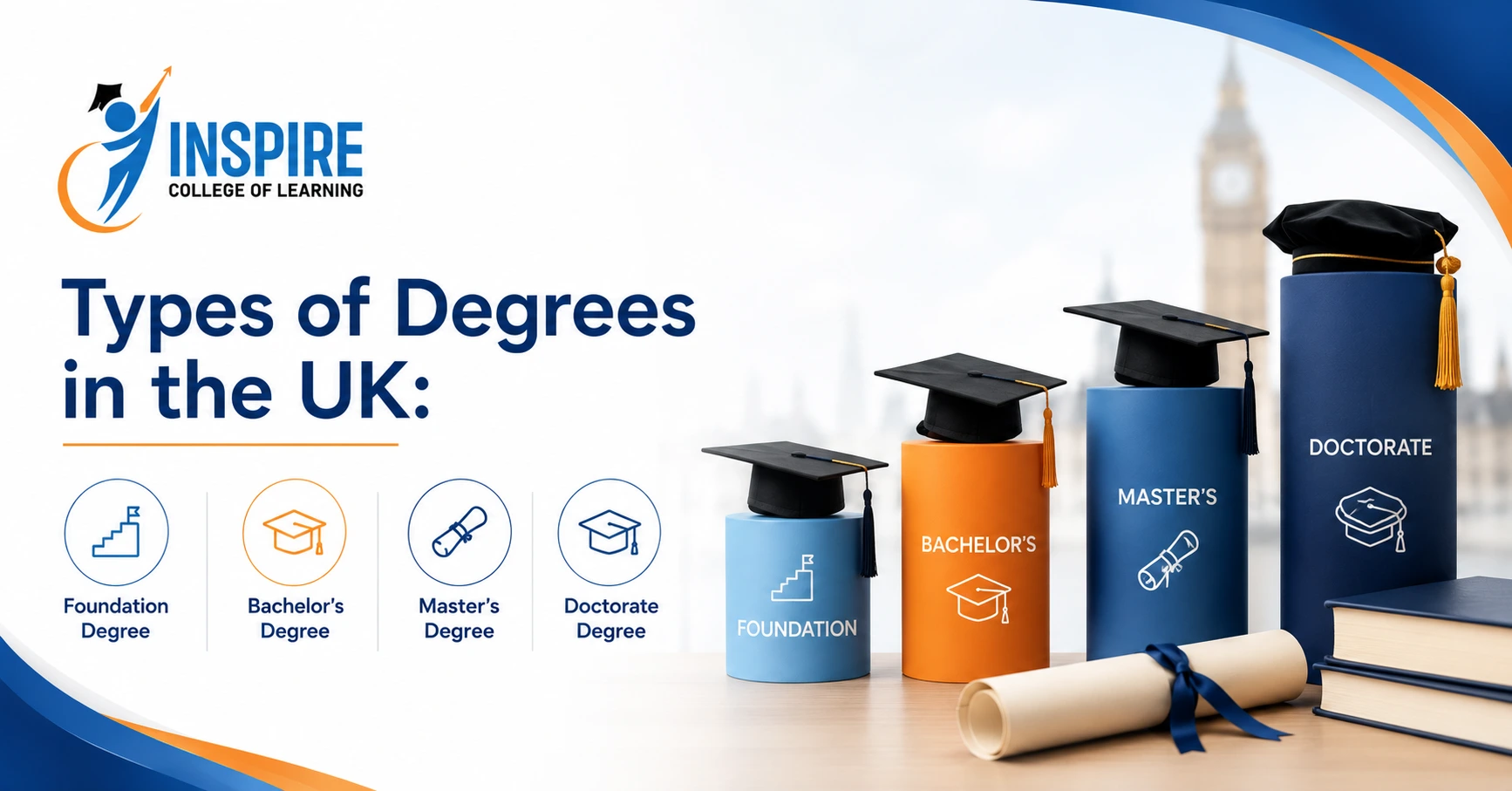
The British higher education system contains more qualifications than can comfortably fit into a list of four. Yet, for someone trying to understand the main stages of degree study, four categories provide a useful starting point: foundation degrees, bachelor’s degrees, master’s degrees and doctoral degrees.
In England, Wales and Northern Ireland, these broadly move through Levels 5, 6, 7 and 8. The higher number represents a more advanced level of learning, although education is rarely as simple as climbing one step after another.
A foundation degree can provide an early route into higher education. A bachelor’s degree is the main undergraduate award. A master’s develops advanced or specialist knowledge, while a doctorate represents the highest qualification level and usually involves substantial original research.
These are not, however, the only higher education qualifications available in the UK. HNCs, HNDs, Certificates and Diplomas of Higher Education, postgraduate certificates, postgraduate diplomas, integrated master’s degrees and professional qualifications all have their own place.
Understanding that wider picture is more useful than simply memorising four names.
What Are the Main Types of Degrees in the UK?
A simplified UK degree pathway can be viewed like this:
| Degree Type | Typical Level in England, Wales & NI | Typical Full-Time Study | Common Titles | Main Purpose |
|---|---|---|---|---|
| Foundation Degree | Level 5 | Usually 2 years | FdA, FdSc, FdEng | Higher education with strong vocational or professional relevance |
| Bachelor’s Degree | Level 6 | Usually 3 years in much of the UK | BA, BSc, BEng, LLB | Full undergraduate education |
| Master’s Degree | Level 7 | Often 1 year full-time after a bachelor’s | MA, MSc, MBA, MRes | Advanced, specialist or professional study |
| Doctoral Degree | Level 8 | Usually several years | PhD, DPhil, professional doctorate | Advanced independent research or doctoral professional study |
These durations are only general guides.
A degree may take longer because of:
-
part-time study;
-
placements;
-
study abroad;
-
professional training;
-
an integrated course structure;
-
a foundation year; or
-
requirements specific to the profession.
Medicine, dentistry and some other professional degrees, for example, do not fit neatly into the familiar three-year undergraduate model.
Qualification level is therefore a more reliable way of understanding academic progression than course length alone.
1. What Is a Foundation Degree?
A foundation degree is a recognised higher education qualification designed to combine academic learning with professional or workplace-related knowledge.
In England, Wales and Northern Ireland, a foundation degree sits at Level 5.
It normally takes around two years of full-time study, although part-time routes take longer. Foundation degrees are often attractive to people who want higher education with a strong occupational focus or who prefer to study while continuing to work.
Common titles include:
-
Foundation Degree in Arts — FdA
-
Foundation Degree in Science — FdSc
-
Foundation Degree in Engineering — FdEng
A foundation degree is a qualification in its own right. It is not merely an unfinished bachelor’s degree.
At the same time, many foundation degree routes provide opportunities for further study. UCAS explains that foundation degree graduates can normally continue studying for an additional period to work towards a full honours degree, although the precise progression route depends on the programme and institution.
Foundation Degree vs Foundation Year: Are They the Same?
No — and the similarity of their names causes considerable confusion.
A foundation degree is normally a Level 5 higher education qualification.
A foundation year, by contrast, is usually a preparatory year attached to the beginning of a longer degree programme. It is designed to help someone develop the knowledge needed before entering the main undergraduate stages of the course.
For example, someone might enrol on:
BSc (Hons) Business Management with Foundation Year
The foundation year is part of the route towards that BSc. It is not the same qualification as an FdSc or FdA.
The difference is worth checking carefully when comparing university courses.
2. What Is a Bachelor’s Degree?
The bachelor’s degree is probably the qualification most people imagine when they hear the word university degree.
It is the principal undergraduate degree and commonly appears under titles such as:
-
BA — Bachelor of Arts
-
BSc — Bachelor of Science
-
BEng — Bachelor of Engineering
-
LLB — Bachelor of Laws
In England, Wales and Northern Ireland, both ordinary bachelor’s degrees and bachelor’s degrees with honours sit at Level 6.
This is an important point because qualification level is sometimes confused with the honours classification. A bachelor’s degree without honours is not a Level 5 qualification simply because an honours degree represents a fuller undergraduate award; GOV.UK places ordinary and honours bachelor’s degrees at Level 6.
How Long Does a Bachelor’s Degree Take?
A full-time bachelor’s degree commonly takes three years in England, Wales and Northern Ireland.
In Scotland, honours degrees commonly take four years, reflecting the different structure of Scottish higher education.
Some degrees take longer because they include:
-
professional placements;
-
a year abroad;
-
industrial experience;
-
a foundation year;
-
integrated postgraduate study; or
-
professional requirements.
Course length should therefore be checked individually.
What Does a Bachelor’s Degree Prepare You For?
A bachelor’s programme normally develops progressively deeper knowledge of a subject while strengthening abilities such as:
-
critical thinking;
-
research;
-
written and verbal communication;
-
analysis;
-
independent learning;
-
problem-solving; and
-
application of specialist knowledge.
A bachelor’s degree may lead directly into employment, professional training or postgraduate study.
But the word degree should never be treated as a universal passport into every profession.
Careers such as nursing, teaching, social work, engineering and other regulated fields may require particular approved or professionally recognised degree programmes. Someone pursuing one of these professions should investigate the relevant professional requirements before choosing a university course.
3. What Is a Master’s Degree?
A master’s degree is an advanced higher education qualification.
In England, Wales and Northern Ireland, master’s degrees sit at Level 7.
Common awards include:
-
MA — Master of Arts
-
MSc — Master of Science
-
MBA — Master of Business Administration
-
MRes — Master of Research
Many people undertake a master’s after completing a bachelor’s degree, although entry requirements vary substantially between courses and universities.
A master’s can be designed around:
-
advanced study of a specialist subject;
-
professional or practice-based development;
-
research; or
-
a mixture of these elements.
Someone may pursue a master’s to develop expertise in an existing field, enter a new specialism, prepare for research or meet professional requirements.
What matters is not that Level 7 is “higher” than Level 6. What matters is whether Level 7 study serves a useful academic or professional purpose.
Is Every Level 7 Qualification a Master’s Degree?
No.
Level 7 includes several different qualifications.
Alongside master’s degrees, the framework includes postgraduate certificates, postgraduate diplomas, integrated master’s degrees and Level 7 Diplomas.
These qualifications can share the same framework level without becoming the same award.
A Level 7 Diploma, for example, should not automatically be called an MSc, MA or MBA.
For a fuller explanation, see our guide to the difference between a diploma and a university degree and our separate guide to what a Level 7 Diploma is equivalent to.
What Is an Integrated Master’s Degree?
Not every master’s follows the familiar route of:
Bachelor’s degree → graduate → separate master’s degree
An integrated master’s combines undergraduate and master’s-level study within one continuous programme.
Examples include:
-
MEng — Master of Engineering
-
MChem — Master of Chemistry
QAA describes integrated master’s programmes as combining study at bachelor’s honours level with master’s-level study during the later stages of the course.
They commonly take around four years of continuous full-time study, or five years in Scotland, before the person graduates with a master’s award.
This makes them particularly important when discussing “degree stages”, because a person does not necessarily have to finish one degree and then enrol on a completely separate course to reach master’s level.
4. What Is a Doctoral Degree?
A doctorate represents the highest qualification level in the framework used in England, Wales and Northern Ireland.
Doctoral degrees sit at Level 8.
The best-known is the:
PhD — Doctor of Philosophy
Some universities use the title DPhil, while professional doctorates also exist in fields where advanced research is closely connected with professional practice.
A doctorate differs substantially from a conventional undergraduate degree.
Rather than spending most of the programme following a broad set of taught modules, a doctoral researcher typically investigates a much narrower question in great depth.
With academic supervision, the researcher is expected to make an original contribution to knowledge or professional understanding.
A doctorate may be especially relevant for people pursuing:
-
academic research;
-
university research careers;
-
some areas of university teaching;
-
highly specialised research positions; or
-
advanced professional practice where doctoral study is relevant.
But a doctorate should not be viewed as the compulsory final step of education.
The existence of Level 8 does not mean everyone at Level 7 ought to proceed there.
For a researcher, a doctorate may be essential. In many other careers, several years of additional professional experience could be considerably more relevant.
The sensible question is not, “What qualification comes next?”
It is, “Does the next qualification take me somewhere I actually need to go?”
Undergraduate vs Postgraduate Degrees: What Is the Difference?
The four degree types become easier to understand when divided into undergraduate and postgraduate study.
Undergraduate Study
Undergraduate higher education generally includes the first stages of university-level study.
This includes qualifications such as:
-
foundation degrees;
-
bachelor’s degrees;
-
CertHEs;
-
DipHEs;
-
HNCs; and
-
HNDs.
For many people, a bachelor’s degree is their first full university degree.
Postgraduate Study
Postgraduate study normally follows previous higher education and involves more advanced or specialised learning.
Examples include:
-
master’s degrees;
-
postgraduate certificates;
-
postgraduate diplomas; and
-
doctorates.
An integrated master’s is unusual because it combines undergraduate and postgraduate-level study within one continuous course.
The terms undergraduate and postgraduate therefore tell you where a qualification broadly sits in the higher education journey, while the specific qualification title tells you what award is actually being pursued.
Where Do HNCs, HNDs, CertHEs and Diplomas Fit?
University education contains far more than the four degree categories discussed above.
In England, Wales and Northern Ireland, the broader picture includes:
| Qualification | Typical Level |
|---|---|
| Certificate of Higher Education (CertHE) | Level 4 |
| Higher National Certificate (HNC) | Level 4 |
| Diploma of Higher Education (DipHE) | Level 5 |
| Higher National Diploma (HND) | Level 5 |
| Foundation Degree | Level 5 |
| Bachelor’s Degree | Level 6 |
| Master’s Degree | Level 7 |
| Integrated Master’s | Level 7 |
| Postgraduate Certificate | Level 7 |
| Postgraduate Diploma | Level 7 |
| Doctorate | Level 8 |
The table explains why qualification names deserve as much attention as qualification levels.
Several awards can sit beside one another at the same level without being interchangeable.
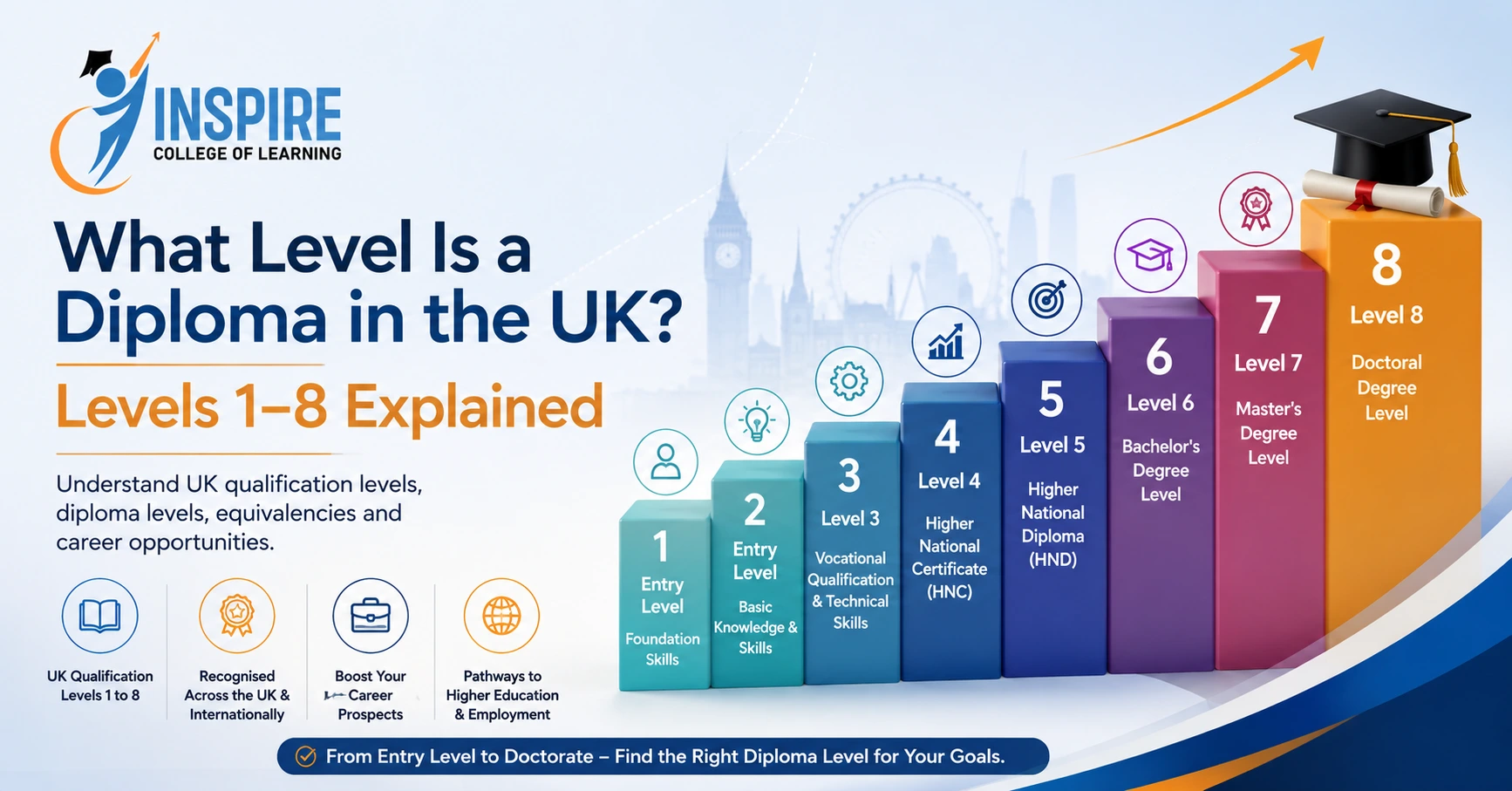
This principle matters especially when comparing diplomas with degrees. Our separate guide to what level a diploma is in the UK explains diploma Levels 1–8 in more detail.
Are the Four Degree Types the Same in Every Country?
No.
Degree terminology varies between education systems.
This becomes particularly important when people search online for “the four types of degrees”, because an answer written for the United States may be different from an answer written for the United Kingdom.
Four Common Degree Types in the United States
US education guidance commonly groups college degrees as:
-
Associate degree
-
Bachelor’s degree
-
Master’s degree
-
Doctoral degree
A Simplified UK Degree Pathway
In the UK context, a useful progression can instead be described as:
-
Foundation degree
-
Bachelor’s degree
-
Master’s degree
-
Doctoral degree
An associate degree is therefore not simply the American name for every UK foundation degree, and qualifications should not be converted from one education system to another solely because they appear at a similar stage.
Anyone planning international study or employment should check the formal recognition requirements used by the destination institution or authority.
Do Degree Levels Work Differently in Scotland?
Yes.
Scotland uses the Scottish Credit and Qualifications Framework (SCQF), which contains 12 levels.
That is different from the Level 1–8 structure commonly discussed for qualifications in England, Wales and Northern Ireland.
Within the Scottish framework:
-
an ordinary bachelor’s degree is normally SCQF Level 9;
-
a bachelor’s degree with honours is normally SCQF Level 10;
-
a master’s degree sits at SCQF Level 11; and
-
a doctoral degree sits at SCQF Level 12.
This is why statements such as “a master’s is Level 7 in the UK” need qualification.
Level 7 applies to the framework used in England, Wales and Northern Ireland. Scottish qualifications use different numbering.
The academic standard may be comparable within the wider UK framework, but the numbers themselves are not interchangeable.
Which Type of Degree Should You Choose?
The highest qualification is not automatically the wisest qualification.
A useful degree is one that fits the person's present circumstances and intended destination.
A simple way to think about the options is:
| Your Goal | Route Worth Investigating |
|---|---|
| Enter higher education through a shorter, vocationally focused route | Foundation degree |
| Complete a full undergraduate university education | Bachelor’s degree |
| Develop advanced specialist or professional knowledge | Master’s degree |
| Combine undergraduate and master’s study | Integrated master’s |
| Undertake advanced original research | Doctorate |
| Enter a regulated profession | Check the profession’s approved qualification requirements first |
Before choosing, ask several practical questions.
What qualification does my career actually require?
Some occupations simply value higher education.
Others require a very specific approved degree.
That difference should be established before enrolment.
What qualifications do I already have?
There is little sense in choosing a course far below your existing level, nor in entering advanced study without the preparation needed to succeed.
Do I need a degree at all?
Not every career requires a traditional university degree.
Depending on the profession, apprenticeships, professional diplomas, higher technical qualifications and occupational experience may also be valuable routes.
What will the course cost?
Consider not only tuition fees but also:
-
living costs;
-
materials;
-
travel;
-
time away from employment; and
-
the opportunity cost of several years of study.
What happens afterwards?
A qualification becomes easier to judge when you know what comes after it.
Check whether the programme provides:
-
professional eligibility;
-
graduate employment opportunities;
-
progression to further study;
-
recognised credits; or
-
entry into a particular profession.
The name printed across a university prospectus matters less than where the qualification can realistically take you.
Can You Progress from One Degree Type to Another?
Often, yes, but education does not have one compulsory sequence.
A conventional route might look like:
Foundation Degree → Bachelor’s Degree → Master’s Degree → Doctorate
Another person might begin directly with a bachelor’s.
Someone else may complete a bachelor’s and enter employment without ever needing postgraduate study.
Another may enrol on an integrated master’s and reach Level 7 without completing a separate bachelor’s and master’s course.
A foundation degree graduate may potentially progress to an honours programme through an appropriate top-up route.
Postgraduate entry can also vary according to previous qualifications, professional experience and university requirements.
Qualification frameworks make progression easier to understand; they do not dictate that every person must collect each qualification in order.
What Can Different Degree Levels Lead To?
Degree level alone cannot predict a person's career.
A bachelor's degree does not guarantee employment, and a doctorate does not automatically produce a better career than a master's.
What a qualification can lead to depends on several factors:
-
subject studied;
-
university;
-
professional accreditation;
-
practical experience;
-
employer requirements;
-
labour-market conditions;
-
location; and
-
the individual's wider skills.
A bachelor's degree might be sufficient for one profession but only the starting point for another.
A master's may provide important specialist knowledge in one field while being unnecessary in another.
A doctorate can be essential to a particular research career yet irrelevant to another highly successful professional route.
Education becomes valuable when its level, subject and purpose meet.
Where Do Professional Diplomas Fit into This Picture?
A university degree is only one form of higher-level education.
Professional diplomas may provide another route for people who want structured study in fields such as:
-
business and management;
-
health and social care;
-
law;
-
information technology;
-
cyber security;
-
education;
-
psychology; and
-
other professional areas.
Some diplomas occupy higher qualification levels and may support professional development or progression to further study.
But a professional diploma should not be called a university degree merely because the two qualifications happen to share a framework level.
For example, a Level 6 Diploma and a bachelor's degree can both sit at Level 6 in England, Wales and Northern Ireland while remaining different qualifications.
Likewise, a Level 7 Diploma does not become an MA, MSc or MBA simply because master's degrees also sit at Level 7.
Understanding this difference protects applicants from one of the most common mistakes in qualification comparison.
Building a Flexible Qualification Route with Inspire College of Learning
Not everyone reaches higher education immediately after school.
Some people return after years in employment. Others want to develop management knowledge while continuing to work. Some are preparing for a career change, while international applicants may want a UK professional qualification that can be studied online.
For such people, a professional qualification can form part of a broader learning journey.
Inspire College of Learning provides online professional qualifications across different subjects and qualification levels, allowing applicants to explore options suited to their existing education and professional aims.
Before enrolling, prospective applicants should still examine the details carefully:
-
qualification title;
-
awarding organisation;
-
level;
-
entry requirements;
-
assessment;
-
recognition; and
-
progression opportunities.
If university study is the eventual destination, confirm the university's admission or credit-recognition requirements before beginning the preceding qualification.
A route should be planned from its destination backwards.
From Foundation Degree to Doctorate: What Should You Remember?
The four major degree stages provide a useful map of UK higher education:
Foundation Degree — Level 5
Bachelor’s Degree — Level 6
Master’s Degree — Level 7
Doctorate — Level 8
These levels apply to the framework used in England, Wales and Northern Ireland; Scotland uses the separate SCQF system.
More importantly, the list is a guide rather than a compulsory ladder.
Not everyone needs a foundation degree before a bachelor's. Not every bachelor's graduate needs a master's. A master's does not inevitably call for a doctorate.
The purpose of education is not to reach the highest number available.
It is to reach the level of knowledge required for the life, profession or intellectual work one intends to pursue.
Once that purpose is clear, qualification titles become much easier to understand.
Frequently Asked Questions
Q1. What are the four main types of degrees in the UK?
A useful simplified UK pathway includes foundation degrees, bachelor’s degrees, master’s degrees and doctoral degrees. These are not the only higher education qualifications available, but they represent four important stages of degree study.
Q2. Is a foundation degree a real degree?
Yes. A foundation degree is a recognised higher education qualification. In England, Wales and Northern Ireland it sits at Level 5 and commonly takes around two years of full-time study.
Q3. Is a foundation degree the same as a foundation year?
No. A foundation degree is a standalone higher education qualification, normally at Level 5. A foundation year is generally a preparatory stage attached to the beginning of a longer degree programme.
Q4. Is a bachelor’s degree higher than a foundation degree?
Yes. A foundation degree is Level 5, while ordinary bachelor’s degrees and bachelor’s degrees with honours sit at Level 6 in England, Wales and Northern Ireland.
Q5. What level is a bachelor’s degree?
A bachelor’s degree is normally Level 6 in England, Wales and Northern Ireland. In Scotland, an ordinary bachelor’s degree is generally SCQF Level 9 and an honours degree is SCQF Level 10.
Q6. What level is a master’s degree?
A master’s degree sits at Level 7 in England, Wales and Northern Ireland. In Scotland, master’s degrees sit at SCQF Level 11.
Q7. What is an integrated master’s degree?
An integrated master’s combines bachelor’s-level and master’s-level study within one continuous programme. Examples include the MEng and MChem. These programmes commonly take four years full-time, or five years in Scotland.
Q8. What is the highest degree you can get in the UK?
A doctorate, such as a PhD or DPhil, represents the highest qualification level. Doctorates sit at Level 8 in England, Wales and Northern Ireland and SCQF Level 12 in Scotland.
Q9. Do you need a master’s degree before doing a PhD?
Not always. Doctoral entry requirements vary between universities, subjects and research programmes. Some programmes expect a relevant master’s degree, while others may accept applicants with a strong bachelor’s degree or other suitable experience.
Q10. Are the four degree types the same in the UK and US?
No. In the United States, the four common college degree categories are usually associate, bachelor’s, master’s and doctoral degrees. In a simplified UK pathway, foundation, bachelor’s, master’s and doctoral degrees are more relevant categories. Qualification structures should therefore be compared carefully rather than assumed to be identical.