What is Level 7 Diploma?
Introduction
If you're considering a Level 7 Diploma, you've probably come across terms such as master's degree, postgraduate qualification, MBA, and RQF Level 7. It's easy to see why many people ask the same question:
"What is a Level 7 Diploma equivalent to?"
The short answer is that a Level 7 Diploma sits at the same academic level as a master's degree within the UK qualifications framework. However, that does not mean a Level 7 Diploma is the same qualification as a Master of Science (MSc), Master of Arts (MA), or Master of Business Administration (MBA).
If you want to learn more about Qualifications levels then check out this guide the Best Business Management Qualifications for Career Growth in 2026, which explains how Level 3 through Level 7 qualifications support different career stages.
Understanding this distinction is important because it affects your study options, career planning, and progression to further education.
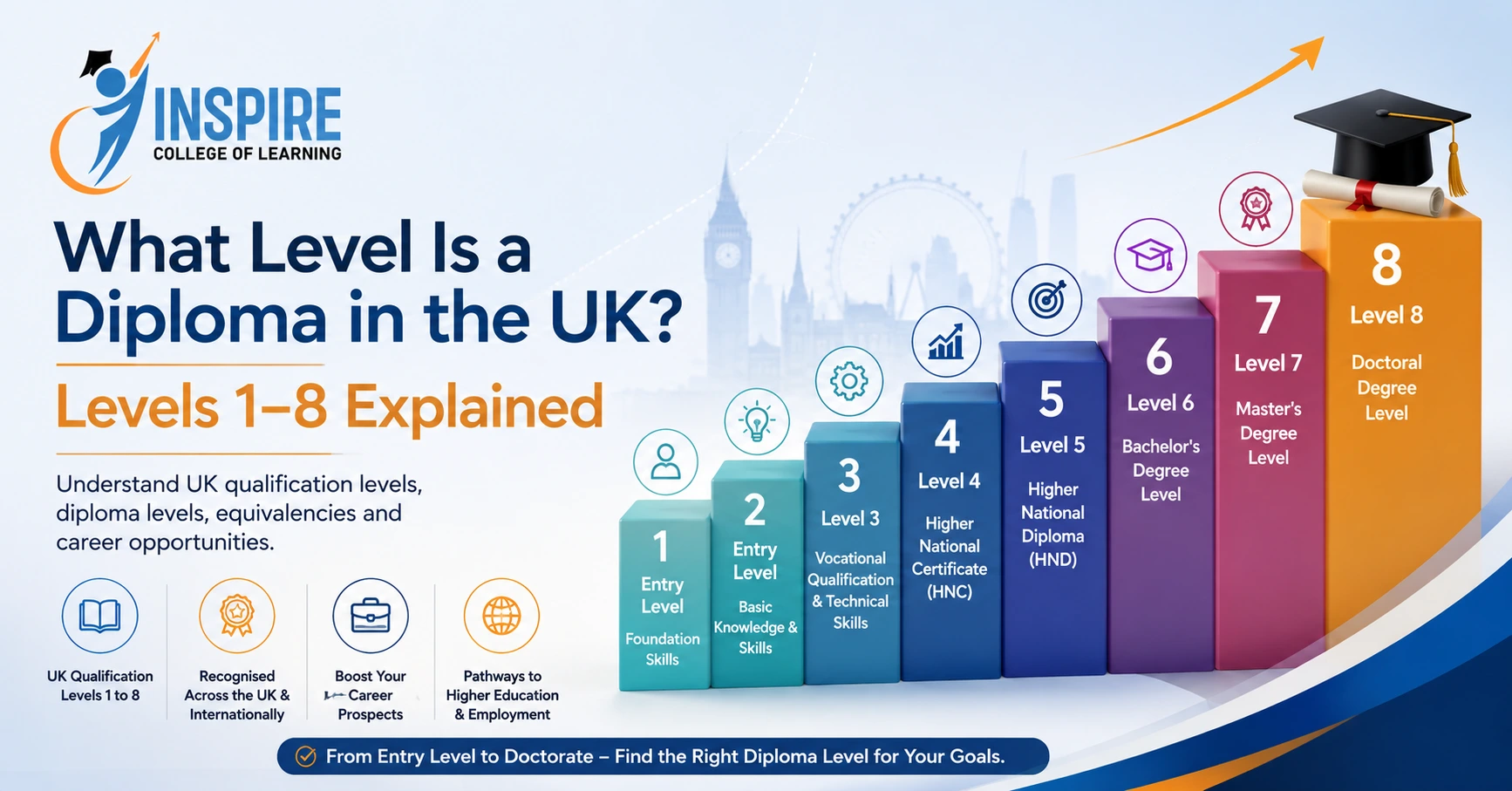
Understanding the UK Qualification Framework
To understand Level 7, it helps to know how UK qualifications are organised.
Qualifications are grouped into different levels based on the knowledge, skills, and complexity of learning expected.
A simplified progression looks like this:
|
Qualification Level |
Typical Equivalent |
|
Level 3 |
A Levels |
|
Level 4 |
First year of a bachelor's degree |
|
Level 5 |
Second year of a bachelor's degree |
|
Level 6 |
Bachelor's degree with honours |
|
Level 7 |
Master's degree level |
|
Level 8 |
Doctorate (PhD) |
Level 7 represents advanced study designed for professionals who already have higher education qualifications or significant management experience.
What Does "Equivalent" Actually Mean?
One of the biggest misconceptions is that "equivalent" means "identical."
It doesn't.
When people say a Level 7 Diploma is equivalent to a master's degree, they mean it is equivalent in academic level, not in qualification type.
For example:
- A Level 7 Diploma
- An MBA
- An MSc
- An MA
all sit at Level 7 within the UK qualifications framework.
However, they have different structures, assessment methods, learning outcomes, and awarding institutions.
Think of it this way: two qualifications can operate at the same level while serving different purposes.
Is a Level 7 Diploma Equivalent to a Master's Degree?
Yes—in terms of academic level.
A recognised Level 7 Diploma demonstrates postgraduate-level learning and requires learners to engage with advanced concepts, critical thinking, strategic decision-making, and professional practice.
However, there are important differences.
A Master's Degree Usually Includes
- University-based study
- Academic research
- Independent dissertation or major project
- Broader theoretical exploration
A Level 7 Diploma Usually Includes
- Assignment-based assessment
- Practical application of knowledge
- Workplace-focused learning
- Professional development
- Strategic management and leadership units
Many professionals prefer this practical approach because they can apply what they learn directly in their workplace.
Is a Level 7 Diploma the Same as an MBA?
No.
An MBA is a specific postgraduate degree, while a Level 7 Diploma is a professional postgraduate qualification.
Both operate at Level 7, but they are different qualifications.
A Level 7 Diploma Typically Focuses On
- Strategic leadership
- Organisational management
- Change management
- Corporate governance
- Business improvement
An MBA Typically Includes
- Academic business study
- Research methodology
- Consultancy projects
- Dissertation or capstone project
- Wider business disciplines
Many recognised Level 7 Diplomas also provide progression routes into MBA top-up programmes, allowing learners to complete additional university requirements to obtain an MBA.
For a full comparison, see our guide on Level 7 Diploma vs MBA: Which Is Better in 2026?

Is a Level 7 Diploma Recognised by Employers?
In many industries, yes.
Employers generally focus on three key factors:
- Whether the qualification is regulated
- The knowledge and skills gained
- How those skills are applied in the workplace
For management and leadership roles, employers often value practical leadership ability alongside formal qualifications.
A recognised Level 7 Diploma demonstrates advanced knowledge in areas such as:
- Strategic planning
- Leadership
- Business management
- Organisational performance
- Decision-making
- Managing change
For experienced professionals, these capabilities can be just as important as the qualification title itself.
Who Should Study a Level 7 Diploma?
A Level 7 Diploma is usually designed for professionals who already have management experience or have completed undergraduate-level study.
It may suit:
- Department managers
- Operations managers
- Business owners
- Senior supervisors
- Project managers
- Experienced team leaders
- Professionals preparing for executive roles
Some providers may also accept applicants with substantial professional experience, even if they do not hold a traditional bachelor's degree.
Entry requirements vary between awarding organisations and training providers.
What Subjects Can You Study at Level 7?
Level 7 qualifications are available across several professional disciplines.
Popular areas include:
Strategic Management and Leadership
Designed for professionals preparing for senior leadership roles.
Business Management
Focuses on strategic planning, organisational development, and business performance.
Human Resource Management
Develops advanced knowledge of people management and organisational strategy.
Project Management
Supports professionals managing complex projects and programmes.
Healthcare Management
Suitable for experienced healthcare professionals progressing into leadership positions.
The Qualifi Level 7 Diploma in Strategic Management and Leadership is one of the most widely chosen routes for professionals aiming to strengthen strategic leadership skills.
If you're comparing different qualification levels before making a decision, it's worth reading
Can a Level 7 Diploma Lead to Further Study?
Yes.
One of the main advantages of recognised Level 7 qualifications is that they can provide progression opportunities.
Depending on the university and programme, learners may progress to:
- MBA top-up programmes
- Master's top-up programmes
- Other postgraduate qualifications
- Continuing professional development programmes
Universities set their own admission requirements, so progression is never automatic, but many institutions recognise Level 7 qualifications as suitable preparation for further postgraduate study.
Career Benefits of a Level 7 Diploma
Completing a Level 7 Diploma can support progression into senior management roles by developing practical leadership and strategic thinking skills.
Depending on experience, career opportunities may include:
- Operations Manager
- Senior Project Manager
- Business Consultant
- Department Director
- Strategic Planning Manager
- Regional Manager
- Business Development Manager
- Senior Leadership Roles
While qualifications alone do not guarantee promotion, they can strengthen a professional profile when combined with relevant workplace experience.
How Does a Level 7 Diploma Compare with a Level 6 Qualification?
Understanding the difference between Level 6 and Level 7 is another common area of confusion.
|
Level 6 |
Level 7 |
|
Bachelor's degree level |
Master's degree level |
|
Focus on advanced undergraduate knowledge |
Focus on postgraduate strategic learning |
|
Suitable for graduates and developing professionals |
Suitable for experienced professionals and senior managers |
|
Broader subject knowledge |
Greater emphasis on leadership, strategy, and critical decision-making |
Many learners progress directly from a Level 6 qualification into Level 7 study.

Is a Level 7 Diploma Worth It in 2026?
For many professionals, it can be.
A Level 7 Diploma may be particularly valuable if you:
- Want to progress into senior management
- Need a flexible study option
- Prefer assignment-based assessment
- Plan to continue towards an MBA later
- Wish to strengthen strategic leadership skills while working
The value of any qualification depends on how well it aligns with your career goals, existing experience, and long-term plans.
Conclusion
A Level 7 Diploma is equivalent to a master's degree in terms of academic level, but it is not the same qualification as an MA, MSc, or MBA. Instead, it offers a practical postgraduate pathway that focuses on strategic management, leadership, and professional application.
For experienced professionals, it provides an opportunity to develop advanced business and leadership skills while maintaining flexibility and continuing to work. It can also open the door to further postgraduate study, including MBA top-up programmes offered by many universities.
If you're deciding whether Level 7 is the right next step, consider your current experience, career ambitions, preferred learning style, and long-term goals. Choosing a qualification that matches your professional objectives is far more important than focusing on the title alone.
Frequently Asked Questions
Q1. Is a Level 7 Diploma equivalent to a master's degree?
Yes, it is equivalent in academic level within the UK qualifications framework. However, it is a different qualification type from an MSc, MA, or MBA.
Q2. Is a Level 7 Diploma recognised in the UK?
Yes. Regulated Level 7 qualifications are recognised within the UK qualifications framework and can support career progression and further study.
Q3. Can I study a Level 7 Diploma without a degree?
Some providers accept applicants with significant professional experience instead of a bachelor's degree. Entry requirements vary by programme.
Q4. Is a Level 7 Diploma better than a bachelor's degree?
A Level 7 Diploma is at a higher academic level than a bachelor's degree because it represents postgraduate-level study.
Q5. Can I progress from a Level 7 Diploma to an MBA?
Yes. Many universities offer MBA top-up routes for learners who have completed a recognised Level 7 qualification, although entry requirements differ.
Q6. How long does a Level 7 Diploma take to complete?
Most programmes can be completed in approximately 6 to 12 months, depending on the provider and study pace.
Q7. What careers can a Level 7 Diploma support?
It can support progression into senior management, strategic leadership, business consultancy, operations management, project management, and executive-level roles.